
Testing waste and investigating barrier walls
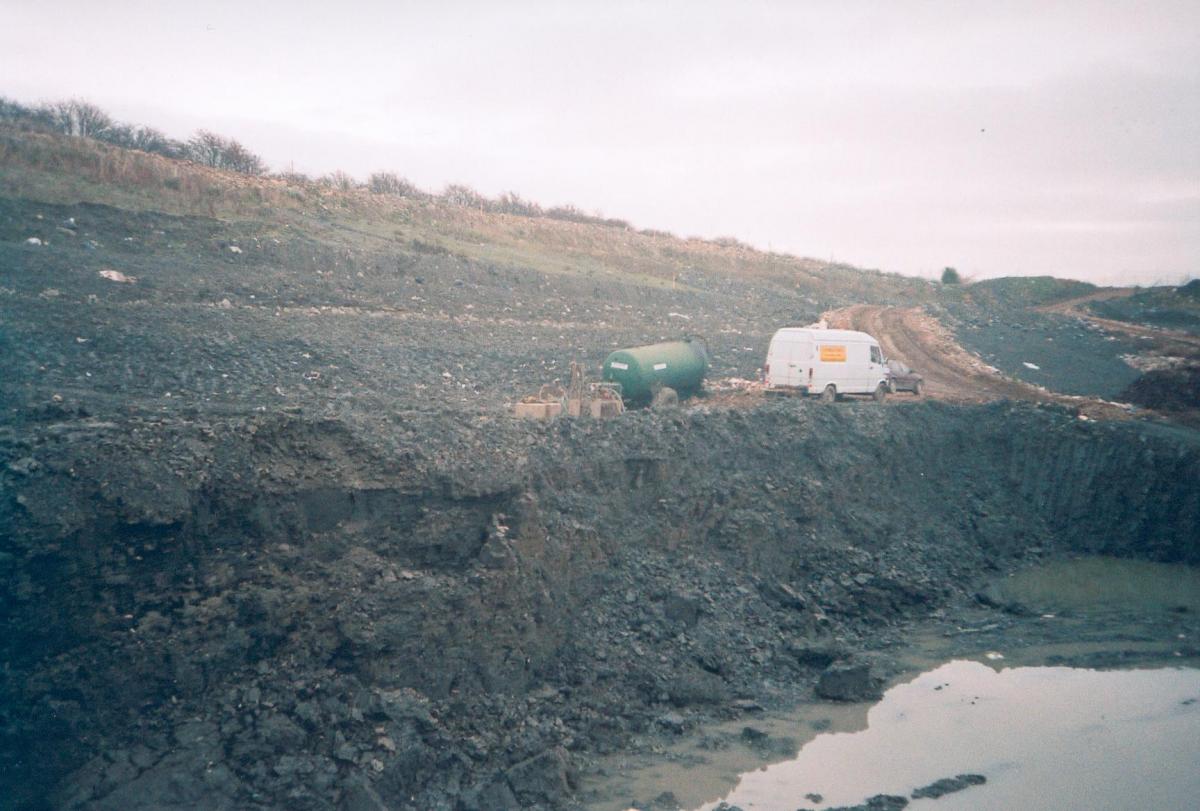 We were approached by Dr Neil Dixon of Loughborough University (now Professor of Engineering) about the possibility of using a pressuremeter to investigate the mechanical properties of municipal solid waste. Most of the work took place at a landfill site in Calvert, Buckinghamshire. The waste was a mixture of residential and commercial residue, not well-sorted, in various stages of degradation and depending on its age could be lightly to heavily compacted.
The primary purpose of the testing was to obtain engineering parameters that would permit the interaction between the body of the waste and the components of the protective barriers to be modelled and quantified.
Self-boring, pushing and pre-boring were all attempted. If metallic materials were encountered then the damage caused to equipment could be spectacular. The most satisfactory results were obtained with a 95mm HPD, where the large expansion capability proved to be helpful. The pockets for this were cut dry, using a modified bit resembling a large hole cutter. The waste is heterogeneous, may be partially saturated and of no particular particle size so the results were variable and the analytical processes were not necessarily appropriate. However shear stiffness from unload/reload cycles proved to be a plausible and repeatable parameter, and it was possible to relate the stiffness values to stress level.
Partly as a result of this work we became interested in the properties of the barriers themselves, and have (in conjunction with Cambridge University) carried out research work on the mechanical properties of man-made and natural barriers, with special attention being paid to permeability.